组成图示
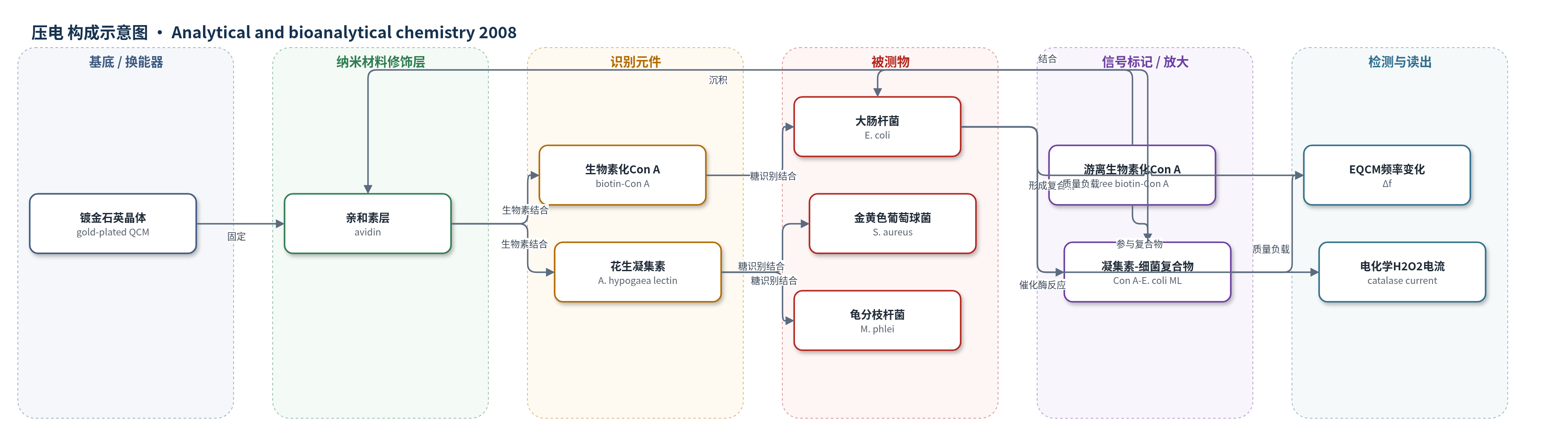
点击图片查看大图 · 依据论文自动绘制
传感器类型
压电(QCM)生物传感器
检测对象
大肠杆菌(Escherichia coli, E. coli)、金黄色葡萄球菌(Staphylococcus aureus, S. aureus)、龟分枝杆菌(Mycobacterium phlei, M. phlei);样品基质为细菌培养液/缓冲液(LB 肉汤、0.1 M 醋酸缓冲液)
检测原理
凝集素固定于镀金石英晶体表面,通过识别细菌细胞壁糖基与目标菌结合。结合事件使晶体表面质量增加,压电谐振频率下降,EQCM 通过 Δf 实现无标记实时检测。采用亲和素–生物素体系固定生物素化 Con A 可提高固定稳定性;当溶液中存在游离生物素化 Con A 时,其同时结合晶体表面与大肠杆菌,形成 Con A–大肠杆菌多层复合物,产生质量放大,使灵敏度提高约 8 倍。Δf 与细菌浓度在一定范围内相关,可用于定量。EQCM 还可施加 +0.6 V 电位,通过细菌过氧化氢酶消耗 H2O2 引起电流变化,辅助区分活菌与死菌。
检测灵敏度
LOD: approximately 1.0×10^4 cfu mL−1;线性范围: 5.0×10^6–2.0×10^7 cfu mL−1;动态范围: 2.0×10^5–2.0×10^8 cfu mL−1;过滤法: 1.0×10^3 cfu mL−1 产生约65 Hz;信号放大: 8倍
效应效果
该传感器选择性良好:Con A 对大肠杆菌、金黄色葡萄球菌正响应,对龟分枝杆菌无响应;花生凝集素对金黄色葡萄球菌、龟分枝杆菌正响应,对大肠杆菌无响应,可用凝集素阵列区分菌种。负对照无显著频率变化,非特异吸附被最小化。重现性方面,极化金表面 Con A 固定 RSD 10%,亲和素固定 RSD 8%,生物素化 Con A 固定 77±10 Hz;6.6×10^6 cfu mL−1 大肠杆菌八次测量 RSD 12%。单晶可重复使用 25 次。过滤富集法在 1.0×10^3 cfu mL−1 大肠杆菌下约 60 min 产生 65 Hz。电化学法中,1×10^5 cfu mL−1 大肠杆菌结合后 H2O2 信号比自由细菌小 87%,可初步区分活菌。
传感器的构成
- 基底/换能器:镀金石英晶体(gold-plated quartz crystal, 9 MHz AT-cut QCM),提供压电换能并作为电化学工作电极。
- 识别元件固定层:亲和素(avidin)固定于金表面,提供生物素结合位点以固定生物素化凝集素。
- 识别元件:生物素化刀豆蛋白A(biotinylated Con A)或生物素化花生凝集素(biotinylated Arachis hypogaea lectin),识别细菌表面糖基。
- 封闭剂:牛血清白蛋白(BSA)用于封闭非特异吸附位点,降低细菌非特异结合。
- 信号放大元件:游离生物素化刀豆蛋白A(free biotinylated Con A)与大肠杆菌结合,形成凝集素–细菌复合物。
- 信号层:Con A–大肠杆菌多层复合物(Con A–E. coli multilayers)沉积于晶体表面,增加质量负载。
中文摘要
本文提出利用凝集素构建微生物生物传感器。将凝集素固定于镀金石英晶体表面,采用电化学石英晶体微天平(EQCM)对细菌与凝集素的结合事件进行直接压电无标记转换。以刀豆蛋白A(Con A)和大肠杆菌为模型体系,比较了非极化、极化(−0.200 V)金表面直接吸附以及亲和素–生物素固定等凝集素固定方式。结果表明,通过亲和素–生物素固定 Con A 的晶体对大肠杆菌浓度在 5.0×10^6–2.0×10^7 cfu mL−1 范围内呈线性响应;当分析液中含有游离生物素化 Con A 时,由于多个凝集素结合到细菌细胞壁并形成 Con A–大肠杆菌多层复合物,灵敏度显著提高,检出限约为 1.0×10^4 cfu mL−1,且非特异吸附得到抑制。利用 Con A 和花生凝集素对大肠杆菌、金黄色葡萄球菌和龟分枝杆菌获得不同响应谱,证明细菌鉴别可行。通过过滤游离及凝集素结合细菌并将滤膜引入测量池,可在 1.0×10^3 cfu mL−1 大肠杆菌下获得显著频率变化,并初步结合电化学测定细菌过氧化氢酶活性以区分活菌与死菌。
英文摘要
The use of lectins for microorganism biosensors fabrication is proposed. Lectins are immobilised onto a gold-plated quartz crystal for direct piezoelectric label-free transduction of the bacteria-lectin binding event using an electrochemical quartz crystal microbalance (EQCM). Concanavalin A (Con A) and Escherichia coli were used for the evaluation of the lectin immobilisation method and the biosensor performance. Adsorption on nonpolarised and polarised (-0.200 V) gold-coated quartz crystals and immobilisation through avidin-biotin binding were checked for Con A surface attachment. Lectin-bacteria binding was evaluated in all cases. With a crystal modified with Con A via avidin-biotin immobilisation we obtained a linear calibration plot between 5.0 x 10(6) and 2.0 x 10(7) cfu mL(-1) by measuring frequency changes with E. coli concentration 1 h after bacteria addition. A remarkable increase in sensitivity was achieved when the analytical solution contained free biotinylated Con A, as a consequence of multiple lectin adhesion to Escherichia coli cell wall, which produced an accumulation of Con A-E. coli conjugates in the form of multilayers at the electrode surface. A detection limit of approximately 1.0 x 10(4) cfu mL(-1) was achieved. Moreover nonspecific adsorptions were minimised. Using Con A and lectin from Arachis hypogaea, different response profiles were achieved for Escherichia coli, Staphylococcus aureus and Mycobacterium phlei, thus demonstrating the feasibility of bacteria discrimination. An approach involving filtering of free and lectin-bound bacteria and introduction of a filter in the measuring cell allowed a significant frequency change to be obtained for an E. coli concentration of 1.0 x 10(3) cfu mL(-1) in order to further increase the sensitivity and discriminate between viable and nonviable cells; an approach using electrochemical measurements of bacterial catalase activity was also checked.