组成图示
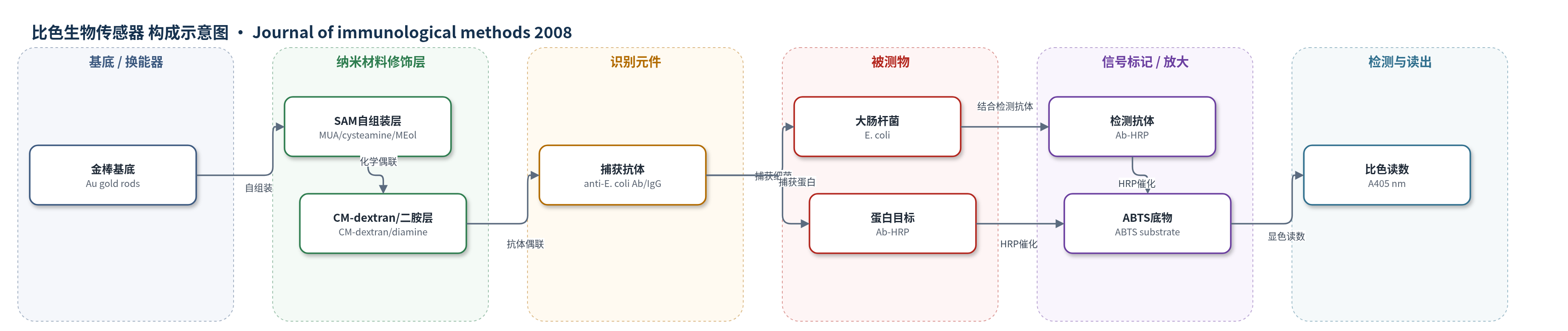
点击图片查看大图 · 依据论文自动绘制
传感器类型
比色生物传感器
检测对象
HRP标记抗大肠杆菌抗体(Ab-HRP,PBS含0.1% Tween和0.5% BSA)、大肠杆菌(Escherichia coli, E. coli,PBS重悬菌液)
检测原理
金表面先经硫醇自组装形成SAM,再通过EDC/NHS或环氧氯丙烷化学偶联CM-dextran、长链二胺或抗体,构建免疫识别界面。未标记捕获抗体固定后,目标物(Ab-HRP蛋白或大肠杆菌)与抗体特异性结合,引起界面生物量增加。若目标为大肠杆菌,HRP标记检测抗体再结合细菌表面表位;若目标本身为Ab-HRP,则其携带的HRP直接位于界面。随后加入ABTS底物,HRP催化ABTS氧化生成有色产物,405 nm吸光度随目标浓度增加而升高。该体系以酶催化显色实现信号放大,但SAM厚度、抗体取向和表面电荷会改变非特异吸附与空间可及性,导致细菌检测中特异信号被非特异吸附掩盖。
检测灵敏度
LOD: around 2 nM Ab-HRP;LOD: down to 5×10^5 cell/ml E. coli
效应效果
蛋白检测中,MUA、MUA-二胺和CM-dextran等SAM策略可将Ab-HRP非特异吸附较裸金降低约50%–60%,各表面性能相近,Ab-HRP检出限约2 nM;羧基偶联抗体通常优于氨基偶联。大肠杆菌检测中,所有SAM免疫功能化表面均未获得可接受特异捕获,在10^1–10^9 cells/ml范围内无明确正信号,反而出现细菌非特异吸附导致的负信号,BSA封闭无效。相比之下,裸金抗体物理吸附加BSA封闭可获得类似微孔板免疫检测趋势,大肠杆菌检出限降至5×10^5 cells/ml。作者提出,对细菌等大尺寸复杂目标,物理吸附是比SAM偶联更简单、低成本且可行的金表面免疫功能化策略。
传感器的构成
- 基底:金棒/金表面(Au),提供惰性、稳定且可硫醇自组装的功能化基底。
- SAM修饰层:巯基十一烷酸(MUA)、半胱胺(cysteamine)或巯基乙醇(MEol)等硫醇自组装,提供-COOH、-NH2或-OH反应位点并降低非特异吸附。
- 聚合物/二胺修饰层:CM-dextran或2,2'-(ethylenedioxy)bis(ethylamine)经EDC/NHS或环氧氯丙烷偶联,提供亲水抗污层和抗体偶联位点。
- 识别元件:未标记抗大肠杆菌多克隆抗体(anti-E. coli Ab)或抗兔IgG(goat anti-rabbit IgG)固定于表面,用于特异性捕获目标蛋白或细菌。
- 信号标记物:HRP标记抗大肠杆菌抗体(Ab-HRP)作为检测抗体,与捕获的大肠杆菌结合后提供HRP酶活性。
- 酶底物/显色剂:ABTS liquid substrate与ABTS-Enhancer(11:1)在HRP催化下生成405 nm有色产物。
- 封闭剂:BSA(2% w/v)或乙醇胺(ethanolamine)封闭剩余反应位点,减少非特异吸附。
中文摘要
表面功能化对免疫分析和生物传感器开发至关重要,可确保目标物的选择性捕获与检测。本文比较了多种基于自组装单分子层(SAM)和抗体偶联的金表面功能化策略/化学,用于蛋白和细菌检测。第一部分总结了各方案的优化,并以酶标蛋白作为模型目标,从降低生物分子非特异吸附和保持特异检测能力两方面评价其效率,考察了硫分子长度与浓度、自组装时间与温度、聚合物引入以及抗体偶联策略等参数的影响。三种表现最佳的策略为:将抗体偶联到仅含巯基十一烷酸(MUA)的SAM,或偶联到长链亲水二胺或羧甲基葡聚糖(CM-dextran)的SAM。结果表明,在这些体系中抗体可成功引入并保持蛋白检测功能。然而第二部分首次证明,这些化学对细菌检测可能并不适用。文章讨论了可能原因及影响,并提出抗体物理吸附作为细菌检测中替代SAM偶联的金表面免疫功能化策略。
英文摘要
Surface functionalisation is of extreme importance in assay and biosensor development because it ensures the selective capture and detection of the targets of interest. In the present report, we compare the performance of several gold functionalisation strategies/chemistries, based on SAM self-assembly and Ab conjugation, for protein and bacteria detection. The first part of the work summarises the optimisation of the various protocols considered. Their efficiency was initially evaluated in terms of reduction of biomolecule non-specific adsorption and specific detection competence impairment, using as a model-target an enzyme-labelled protein. With this purpose, the effect of several parameters, such as thiomolecule length and concentration, self-assembly time and temperature, polymer incorporation, or Ab conjugation strategy was determined. The three best performing strategies consisted of antibody (Ab) conjugation to self-assembled monolayers (SAM) containing mercaptoundecanoic acid alone, or conjugated to either long-chain hydrophilic diamines or CM-dextran. In the three cases, results demonstrated that Abs had been successfully incorporated and remained functional for protein detection. Nevertheless, as showed in the second part of the work, we demonstrate for the first time that these chemistries can be inadequate for bacteria detection. The possible reasons and implications will be discussed. Ab physisorption is proposed as a cost-effective gold immuno-functionalisation strategy alternative to SAM-based Ab incorporation for bacteria detection.