组成图示
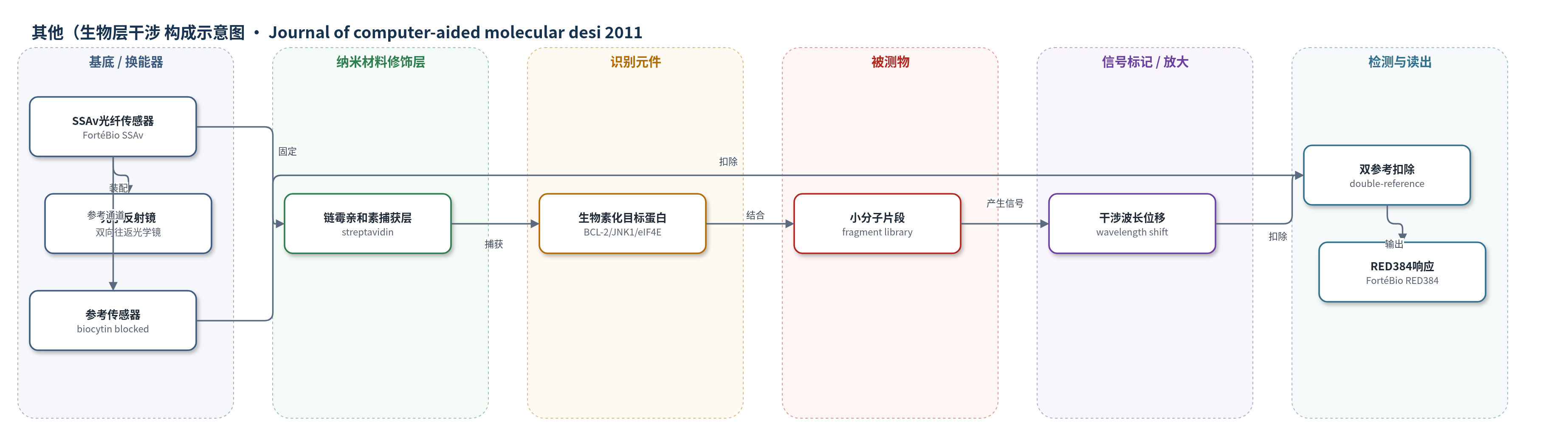
点击图片查看大图 · 依据论文自动绘制
传感器类型
其他(生物层干涉(BLI)生物传感器)
检测对象
小分子片段化合物(small molecule fragments,含阳性对照 7-甲基鸟苷 7-methyl guanosine);样品基质:384 孔板 DMSO/缓冲液(5% DMSO、1 mM DTT、0.005% P20)
检测原理
BLI 传感器由光纤末端的双向往返光学镜和传感器/缓冲液界面的生物层组成。目标蛋白经生物素化后固定在链霉亲和素传感器上,小分子片段与目标蛋白结合后,生物层厚度或光程发生变化,导致可见光干涉图案向较长波长方向位移。仪器在 384 孔板中依次记录基线、结合和解离,响应以波长位移(pm 或 nm)表示,并随片段浓度增加而增大;通过浓度系列可拟合 kon、koff 和 KD。由于小分子响应通常较小,系统采用双参考扣除:用未结合目标蛋白的 biocytin 封闭参考传感器扣除孔间系统干扰,用缓冲液平行运行扣除漂移。该方法为无标记直接检测,不使用酶或荧光放大。
检测灵敏度
LOD(响应): 平均加3倍标准差,通常 20–30 pm;cut-off: 0.03 nm
效应效果
重现性方面,140 个片段在 JNK1 上三次重复 R>0.98,28/34 个≥0.03 nm 命中三次均出现,其余 6 个两次出现,多数信号距 0.03 nm 截断值 0.01 nm 内;eIF4E 8/9 命中可重复。BLI 初筛命中率:BCL-2 21%、JNK1 24%、eIF4E 3.5%;eIF4E 去除高信号和慢解离后 2.5%,二次确认率 50%,总命中率 1.3%,与生化确认命中率 1.4% 相近。PPI 位点 BLI 与生化命中重叠 52%,68% BLI 命中独有,并发现新骨架。阳性对照 7-甲基鸟苷 KD 在 BLI、SPR、荧光中为 450、390、217 μM,对 eIF4E 有选择性。作者认为 BLI 适用于 PPI 靶点片段筛选。
传感器的构成
- 换能器基底:FortéBio Super Streptavidin Biosensor(SSAv)光纤传感器,含双向往返光学镜与生物层界面,用于产生和读取光干涉信号
- 捕获/固定层:SSAv 表面链霉亲和素(streptavidin),通过生物素-链霉亲和素作用固定目标蛋白
- 识别元件:生物素化目标蛋白(BCL-2、JNK1、eIF4E),经生物素连接酶识别序列 GLNDIFEAQKIEWR 体内生物素化或 biotin-LCLC-NHSS 体外标记,用于结合小分子片段
- 封闭剂:biocytin(生物素己酸)封闭未结合链霉亲和素位点,降低非特异结合
- 参考传感器:biocytin 封闭传感器或生物素化链霉亲和素(biotinylated streptavidin)加 biocytin 封闭,用于双参考扣除
- 样品基质:384 孔板中化合物 DMSO 溶液,最终 5% DMSO,缓冲液含 1 mM DTT 和 0.005% P20 去污剂
中文摘要
基于生物传感器的小分子片段筛选是药物发现中的有价值工具。与许多生化方法相比,该方法可通过检查结合谱和响应,将主要命中与非特异性或非理想相互作用区分开,从而降低假阳性率。生物层干涉(BLI)通过测量可见光从光学层和含感兴趣蛋白的生物层反射所产生的干涉图案变化来监测小分子相互作用,是一种较新的方法。BLI 采用浸入 96 孔或 384 孔板的一次性传感器,并已用模型系统和已知靶点验证,其亲和力常数与结合谱通常与表面等离子共振(SPR)结果相似。作者对 BCL-2、JNK1 和 eIF4E 等蛋白-蛋白相互作用靶点进行了含 6500 个化合物的片段库筛选,并比较命中率。对同时具有蛋白-蛋白相互作用位点和核苷酸结合位点的 eIF4E,BLI 筛选结果与生化高通量筛选结果比较,在 PPI 位点观察到重叠命中,并识别出 BLI 特有的命中。文中还描述了用 SPR 和 BLI 对命中化合物进行评估。
英文摘要
Biosensor-based fragment screening is a valuable tool in the drug discovery process. This method is advantageous over many biochemical methods because primary hits can be distinguished from non-specific or non-ideal interactions by examining binding profiles and responses, resulting in reduced false-positive rates. Biolayer interferometry (BLI), a technique that measures changes in an interference pattern generated from visible light reflected from an optical layer and a biolayer containing proteins of interest, is a relatively new method for monitoring small molecule interactions. The BLI format is based on a disposable sensor that is immersed in 96-well or 384-well plates. BLI has been validated for small molecule detection and fragment screening with model systems and well-characterized targets where affinity constants and binding profiles are generally similar to those obtained with surface plasmon resonsance (SPR). Screens with challenging targets involved in protein-protein interactions including BCL-2, JNK1, and eIF4E were performed with a fragment library of 6,500 compounds, and hit rates were compared for these targets. For eIF4E, a protein containing a PPI site and a nucleotide binding site, results from a BLI fragment screen were compared to results obtained in biochemical HTS screens. Overlapping hits were observed for the PPI site, and hits unique to the BLI screen were identified. Hit assessments with SPR and BLI are described.