组成图示
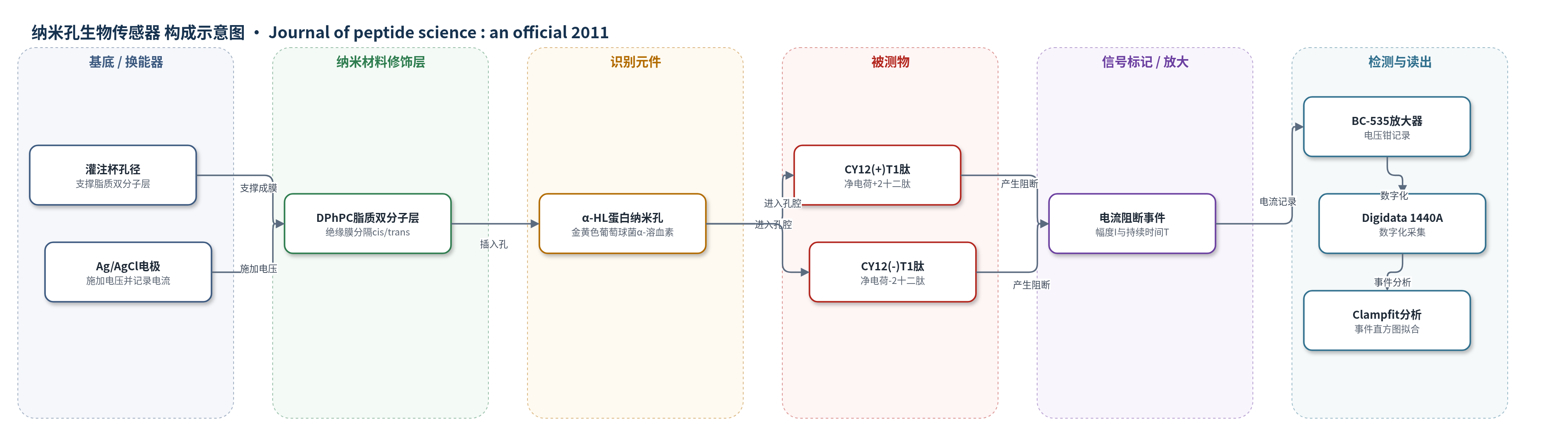
点击图片查看大图 · 依据论文自动绘制
传感器类型
纳米孔生物传感器
检测对象
CY12(+)T1肽(CY12(+)T1 peptide)、CY12(-)T1肽(CY12(-)T1 peptide);样品基质为1 M KCl、10 mM磷酸盐缓冲液(pH 7.8)的纳米孔cis/trans电解质溶液
检测原理
在含α-HL纳米孔的DPhPC脂质双分子层两侧施加电压,1 M KCl电解质形成开放孔电流。肽在电迁移、电渗、孔内静电和疏水相互作用下进入孔腔,部分或完全阻断离子电流;阻断幅度I反映肽占据孔腔的体积和构象,持续时间T反映结合、转位或插入动力学。电压升高时,转位事件T通常缩短,插入事件T延长,因此可用电压依赖性区分两类事件。α-HL孔对Cl-的整流、孔腔两侧能量势垒B1/B2的高度差、肽的偶极矩和净电荷共同决定肽进入方向和优先出口方向,而非仅由简单电泳决定。
检测灵敏度
—
效应效果
在1 M KCl、10 mM磷酸盐(pH 7.8)中,α-HL孔+100 mV开放电流约100 pA,合格+100±2 pA;电流误差±1 pA,时间误差±10%。事件频率受电荷和取向影响:CY12(+)T1 SD 150、VD 35、VU 50、SU 75 events/min;CY12(-)T1 VD 500、SD 400、VU/SU 15。正肽T2 0.34–1.66 ms,负肽0.06–0.31 ms,电压依赖方向不同,可区分转位与插入。作者认为电渗、整流、偶极和电荷决定肽-孔相互作用,对纳米孔传感/测序有价值。
传感器的构成
- 换能器电极:Ag/AgCl电极,连接BC-535头级/放大器,施加跨膜电压并记录离子电流
- 基底/膜支撑:Warner Instruments灌注杯孔径,承载脂质双分子层并分隔cis/trans两室
- 脂质双分子层:1,2-diphytanoyl-sn-glycero-3-phosphocholine (DPhPC),形成绝缘膜并允许α-HL插入
- 纳米孔/识别元件:金黄色葡萄球菌α-溶血素 (α-HL) 蛋白孔,形成单分子通道,肽进入孔腔产生电流阻断
- 被测物/识别对象:CY12(+)T1或CY12(-)T1十二肽,通过电荷、偶极和疏水甲苯基团与孔相互作用
- 电解质/信号介质:1 M KCl和10 mM磷酸盐缓冲液(pH 7.8),提供开放孔电流并支持电迁移/电渗
- 信号读出:BC-535放大器、LPF-8低通Bessel滤波器、Digidata 1440A数字化仪,记录并分析电流阻断事件
中文摘要
纳米孔分析利用α-溶血素等纳米孔作为生物传感器。在含纳米孔的脂质膜两侧施加电压时产生离子电流;分子与孔相互作用时电流被部分阻断,阻断幅度I和持续时间T构成事件特征。本研究分析净电荷+2和-2的肽CY12(+)T1与CY12(-)T1,在不同电压及电极/孔四种取向(VD、VU、SD、SU)下的相互作用。结果表明,CY12(+)T1在VD和SD中事件持续时间随电压变化与转位一致,在VU和SU中仅观察到插入;CY12(-)T1仅在VD和VU中观察到转位。结果可用孔腔两侧两个能量势垒解释,势垒高度差决定优先出口方向。电渗流、电流整流以及肽的偶极矩和电荷也起重要作用,说明除简单电泳外,多种因素共同决定小肽与纳米孔的相互作用。
英文摘要
Nanopore analysis is an emerging technique of structural biology which employs nanopores, such as the α-hemolysin pore, as a biosensor. A voltage applied across a membrane containing a nanopore generates a current, which is partially blocked when a molecule interacts with the pore. The magnitude (I) and the duration (T) of the current blockade provide an event signature for that molecule. Two peptides, CY12(+)T1 and CY12(-)T1 with net charges + 2 and - 2, respectively, were analysed using different applied voltages and all four possible orientations of the electrodes and pore. The four orientations were vestibule downstream (VD), vestibule upstream (VU), stem downstream (SD) and stem upstream (SU) where vestibule and stem refer to the side of the pore on which the peptide was placed and downstream and upstream refer to the application of a positive or negative electrophoretic force, respectively. For CY12(+)T1, the effect of voltage on the event duration was consistent with translocation in the VD and SD configurations, but only intercalation events were observed in the VU and SU configurations. For CY12(-)T1, translocations were only observed in the VD and VU configurations. The results are interpreted in terms of two energy barriers on either side of the lumen of the pore. The difference in height of the barriers determines the preferred direction of exit. Electroosmotic flow and current rectification due to the pore as well as the dipole moment and charge of the peptide also play significant roles. Thus, factors other than simple electrophoresis are important for determining the interaction of small peptides with the pore.