组成图示
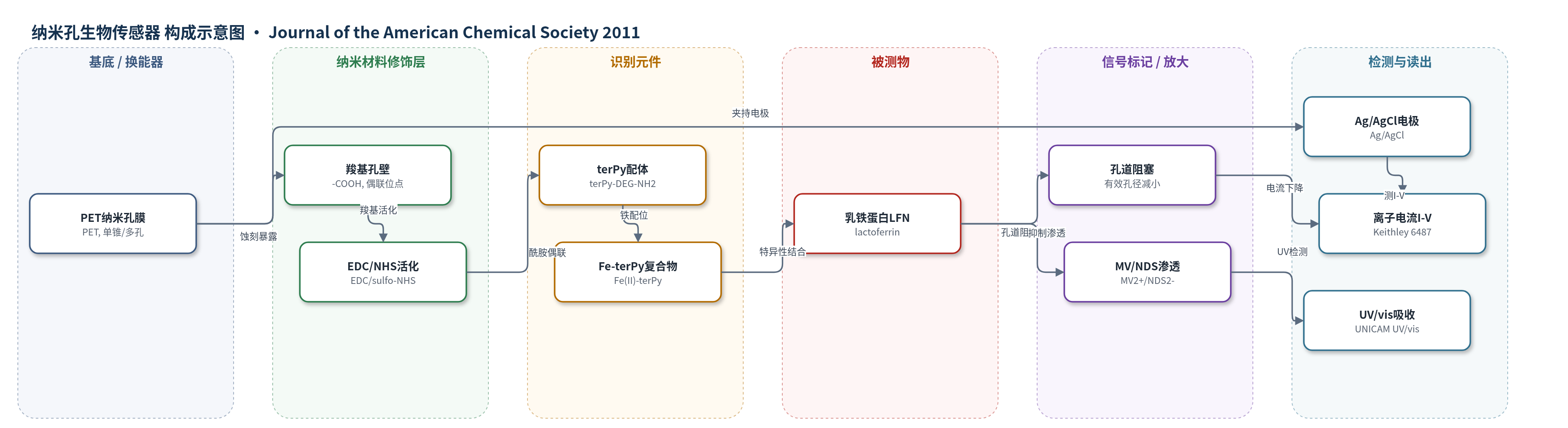
点击图片查看大图 · 依据论文自动绘制
传感器类型
纳米孔生物传感器
检测对象
乳铁蛋白(lactoferrin, LFN);样品基质为 0.1 M KCl 磷酸盐缓冲液(pH 7.0),多孔膜实验为含 10 mM MV2+ 或 NDS2− 的磷酸盐缓冲液(pH 7.0)并加入 100 nM LFN。
检测原理
该传感器以 PET 纳米孔为离子传输通道。蚀刻后孔壁暴露 -COOH,经 EDC/sulfo-NHS 活化后与 terPy-DEG-NH2 的氨基形成酰胺键,再与 FeSO4 配位生成 Fe(II)-terPy。未结合 LFN 时,孔壁负电荷使阳离子电流整流;Fe(II)-terPy 使表面电荷趋于中性,整流消失。当 LFN 进入孔道时,其 N/C 叶天然铁结合位点与螯合 Fe(II) 发生特异性非共价结合,蛋白占据孔内壁并减小有效孔径,产生体积排阻效应,跨孔离子电流随 LFN 浓度增加而下降。1 pM LFN 使 +1 V 电流由 400 pA 降至 95 pA,10 pM 降至 41 pA 并趋于饱和。多孔膜中,LFN 结合后孔道阻塞,MV2+/NDS2− 渗透被抑制,UV 吸收降低。
检测灵敏度
原文未报告 LOD、线性范围、灵敏度斜率或 R^2;仅报告 1 pM LFN 可被检测(+1 V 电流由 400 pA 降至 95 pA,约76%下降;-1 V 由 180 pA 降至 35 pA,约80%下降),10 pM 时 +1 V 降至 41 pA(约90%下降)并趋于饱和。
效应效果
选择性方面,100 nM BSA 未引起单锥孔离子电流明显下降,而随后 100 nM LFN 使 +1 V 电流下降约 80%、-1 V 下降约 95%,表明 Fe(II)-terPy 对 LFN 具有特异性。未修饰羧基孔和仅 terPy 修饰但未铁化的孔在 LFN 存在下均无显著电流变化,说明信号来自金属离子亲和结合而非物理吸附,并显示抗污性。多孔膜实验中,未修饰膜 MV2+ 160 min 渗透 8.4 nmol,Fe-terPy 加 LFN 后仅 0.42 nmol;另一膜由 11.0 nmol 降至 1.9 nmol,约下降 82%。原文未报告稳定性、重现性、实际样品回收率或与 ELISA/HPLC/qPCR 的对比。作者认为该金属亲和纳米孔策略可扩展至 His-tag 蛋白、锌指蛋白等其他金属结合生物分子。
传感器的构成
- 基底/换能器:PET(polyethylene terephthalate)纳米孔膜,提供单锥或圆柱孔道并承载离子电流换能。
- 表面官能团:孔壁羧基(-COOH),由 PET 蚀刻暴露,作为共价偶联位点。
- 偶联剂:EDC(N-(3-dimethylaminopropyl)-N'-ethylcarbodiimide HCl)与 sulfo-NHS(N-hydroxysulfosuccinimide),活化羧基形成 sulfo-NHS 酯。
- 识别配体层:terPy-DEG-NH2(1-amino-5-(2,2':6',2''-terpyrid-4'-yl-oxy)pentane),氨基端与羧基形成酰胺键,terpyridine 端螯合金属。
- 金属识别元件:Fe(II)-terPy 复合物,由 FeSO4(ferrous sulfate)处理形成,提供可及配位位点以结合 LFN。
- 被测物:乳铁蛋白(lactoferrin, LFN),通过天然铁结合位点与 Fe(II)-terPy 结合。
- 信号读出:Ag/AgCl 电极与 Keithley 6487 皮安表/电压源测 I-V 离子电流;多孔膜用 UV/vis 光谱测 MV2+/NDS2− 渗透。
中文摘要
本文报道一种基于金属离子亲和性的新型生物传感平台,用于检测乳铁蛋白(lactoferrin, LFN)。在聚合物膜中制备单锥纳米孔,首先通过碳二亚胺偶联化学将氨基末端三联吡啶(terPy)金属螯合配体共价固定于孔内壁,形成单分子层;随后用硫酸亚铁处理,使孔内形成铁–三联吡啶(iron–terPy)配合物。该配合物作为识别元件,利用 LFN 分子中天然铁结合位点与螯合铁离子之间的特异性非共价相互作用捕获目标蛋白。结合事件改变纳米孔有效孔径和表面电荷,导致跨孔离子电流显著下降,从而实现 LFN 的选择性检测。对照实验表明该传感器具有良好的生物特异性和抗污性。作者还利用含圆柱形纳米孔阵列的多孔膜进行互补实验:当进料液中存在 LFN 时,甲基紫精(MV2+)和1,5-萘二磺酸盐(NDS2−)跨膜渗透被显著抑制,进一步证明 LFN 与孔内铁–terPy 配合物结合造成孔道阻塞。该策略有望扩展到其他具有金属离子结合位点的生物分子识别。
英文摘要
Here we demonstrate a novel biosensing platform for the detection of lactoferrin (LFN) via metal-organic frameworks, in which the metal ions have accessible free coordination sites for binding, inside the single conical nanopores fabricated in polymeric membrane. First, monolayer of amine-terminated terpyridine (metal-chelating ligand) is covalently immobilized on the inner walls of the nanopore via carbodiimide coupling chemistry. Second, iron-terpyridine (iron-terPy) complexes are obtained by treating the terpyridine modified-nanopores with ferrous sulfate solution. The immobilized iron-terPy complexes can be used as recognition elements to fabricate biosensing nanodevice. The working principle of the proposed biosensor is based on specific noncovalent interactions between LFN and chelated metal ions in the immobilized terpyridine monolayer, leading to the selective detection of analyte protein. In addition, control experiments proved that the designed biosensor exhibits excellent biospecificity and nonfouling properties. Furthermore, complementary experiments are conducted with multipore membranes containing an array of cylindrical nanopores. We demonstrate that in the presence of LFN in the feed solution, permeation of methyl viologen (MV(2+)) and 1,5-naphthalenedisulphate (NDS(2-)) is drastically suppressed across the iron-terPy modified membranes. On the basis of these findings, we envision that apart from conventional ligand-receptor interactions, the designing and immobilization of alternative functional ligands inside the synthetic nanopores would extend this method for the construction of new metal ion affinity-based biomimetic systems for the specific binding and recognition of other biomolecules.