组成图示
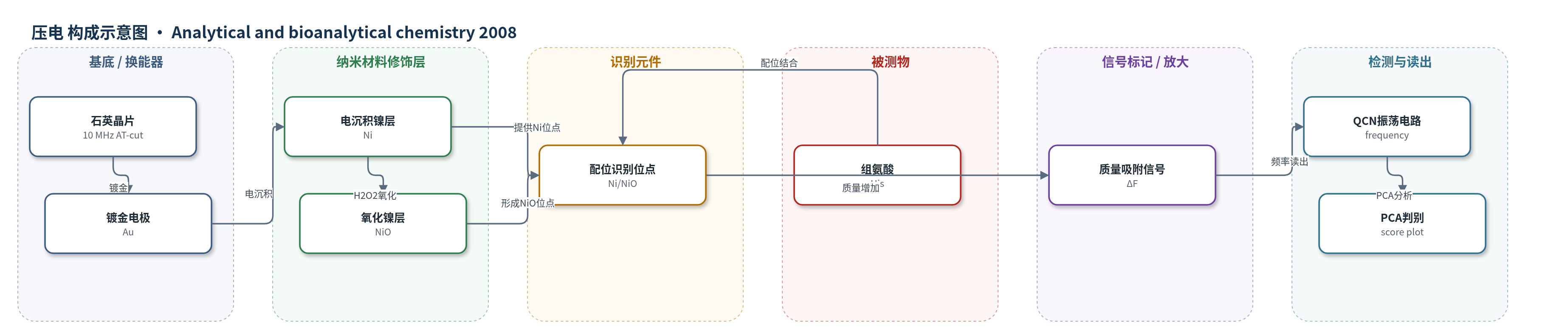
点击图片查看大图 · 依据论文自动绘制
传感器类型
压电(QCM)生物传感器
检测对象
组氨酸(histidine, His);样品基质:水溶液、尿液
检测原理
传感器以镀金AT-cut石英晶片为压电换能器,表面电沉积Ni并经H2O2氧化形成NiO。His溶液接触电极后,His的咪唑基/氨基与Ni/NiO表面发生配位吸附,使晶体活性面积上的质量增加。根据Sauerbrey方程,质量增加引起晶振频率下降,频率偏移ΔF与吸附量及His浓度相关;浓度越高,吸附量越大,频率偏移越大。干燥空气可使His脱附,频率恢复。由于非选择性吸附可能受干扰,研究对每10 s的频率响应进行标准化,并用PCA提取吸附–脱附动力学差异,从而区分His与精氨酸、半胱氨酸、NaH2PO4等干扰物。
检测灵敏度
LOD: 48 mg L−1;线性范围: 100–2000 mg L−1;灵敏度: 0.0307 Hz/mg L−1(摘要)/0.0284 Hz/mg L−1(结果)
效应效果
传感器对500 mg/L His的重复性较好,三个电极各测三次,RSD为2.15%;连续4个月存储测试中响应无显著变化。抗干扰实验显示,在5倍过量(2500 mg/L)或饱和浓度下,甘氨酸、甲硫氨酸、丝氨酸、色氨酸、酪氨酸、尿素、尿酸、氯化铵、硫酸钠、胱氨酸和氯化钾无明显干扰;精氨酸、半胱氨酸和NaH2PO4会产生干扰。PCA显示前两个主成分解释85%以上方差,His与干扰物在得分图中不依赖浓度地聚为不同区域。作者认为该法简单、快速、低成本,检出限48 mg/L适合尿液His检测。
传感器的构成
- 基底/换能器:10 MHz AT-cut石英晶片,双面镀金(Au),作为压电换能器与激励电极
- 修饰层:电沉积镍层(Ni),在Watts镍浴中恒电流沉积,提供His结合位点
- 修饰层:氧化镍层(NiO),由H2O2氧化Ni形成,增强His吸附响应
- 识别元件:Ni/NiO表面配位位点,通过Ni–His配位结合识别组氨酸(His)
- 信号换能:His吸附导致表面质量增加,按Sauerbrey方程产生频率偏移(ΔF)
- 读出装置:自制QCN振荡电路,记录晶体频率变化并用于定量
中文摘要
本研究开发了一种基于石英晶体纳米天平(QCN)的组氨酸(His)检测生物传感器。在镀金石英晶体电极表面恒电流电沉积一层镍,随后用H2O2氧化形成氧化镍(NiO)复合电极。将电极暴露于His溶液时,His与Ni/NiO表面配位吸附,引起晶体频率下降;频率偏移与His浓度在100–2000 mg/L范围内呈线性关系。该传感器检出限为48 mg/L,灵敏度因子为0.0307 Hz/(mg/L)。对多种潜在干扰物检查发现,除精氨酸、半胱氨酸和NaH2PO4外,其他干扰物基本不影响响应。研究进一步采用主成分分析(PCA)处理单晶在不同时间的频率响应数据,利用His与干扰物吸附–脱附动力学差异进行判别;前两个主成分解释了85%以上方差,得分图表明该QCN对His及干扰物具有良好的识别与定量能力。
英文摘要
The aim of the present investigation was to develop a biosensor based on a quartz crystal nanobalance (QCN) for the detection of histidine (His). A thin layer of nickel was electrochemically deposited over the gold crystal electrode and exposed to H(2)O(2) to form nickel oxide. The composite electrode was then used to determine His. The frequency shifts were linear with respect to the concentration of His in solution. His can be measured in the range of 100-2000 mg L(-1). A lower limit of detection of 48 mg L(-1) and a sensitivity factor of 0.0307 Hz/mg L(-1) was obtained. Some possible interferences were checked for, and the performance of the sensor was found to be unaffected by any interference except for those from arginine, cysteine and NaH(2)PO(4). Principal component analysis (PCA) was used to process the frequency response data of the single piezoelectric crystal at various times, considering the different adsorption-desorption dynamics of His and the interfering compounds. Over 85% of the variance in the data was explained by two principal components. A score plot of the data for the first two PCs showed that the modified QCN yields favorable identification and quantification performances for His and the interfering compounds.