组成图示
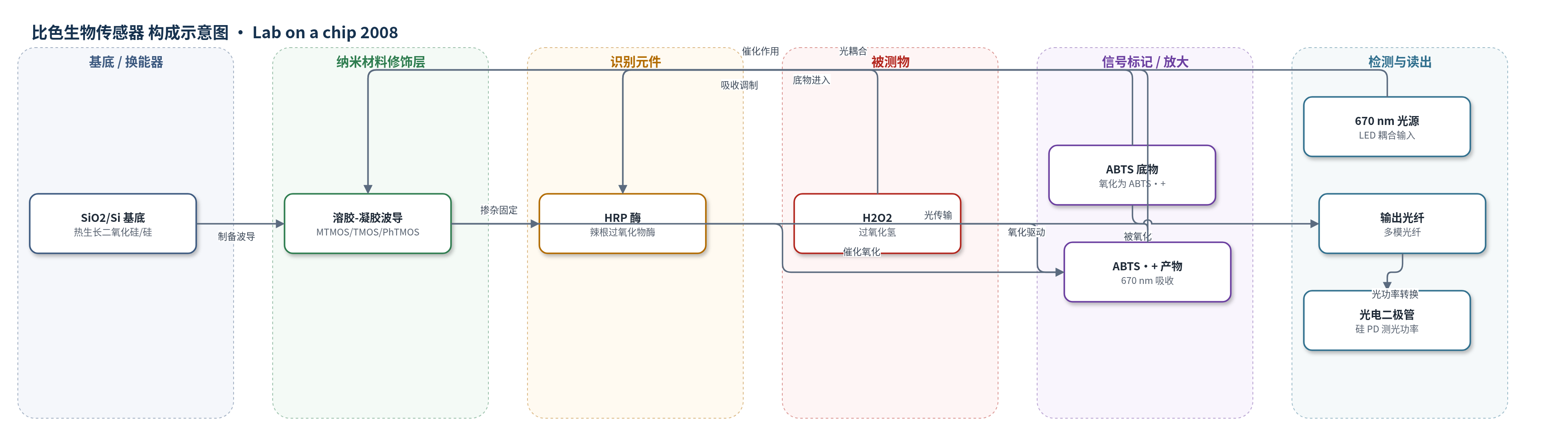
点击图片查看大图 · 依据论文自动绘制
传感器类型
比色生物传感器
检测对象
过氧化氢(H2O2);样品基质为含 ABTS 的 0.1 M 醋酸缓冲液(pH 5)
检测原理
该传感器将辣根过氧化物酶(HRP)直接掺杂到 MTMOS/TMOS/PhTMOS 溶胶-凝胶条状波导中,使识别/催化元件与光波导换能器集成于同一微结构。含 ABTS 和 H2O2 的醋酸缓冲液滴加到波导表面后,因溶胶-凝胶多孔性渗入波导内部。HRP 催化 H2O2 氧化无色 ABTS,生成绿色阳离子自由基 ABTS•+,产物主要位于波导内。670 nm 光从一端耦合进入波导,ABTS•+ 对该波长产生吸收,吸收强度随 H2O2 浓度升高而增大,遵循 Beer–Lambert 定律。输出端光功率经多模光纤传至硅光电二极管,以吸收增加或光功率下降作为信号。全字段波导使整个光场与有色产物相互作用,相比倏逝场传感器可缩短传感长度并降低检出限。
检测灵敏度
LOD: 4.4 × 10⁻⁵ mol L−1 H2O2(正文另报 4.44 × 10⁻⁵ mol L−1);线性范围: 10−5 mol L−1–3 × 10⁻⁴ mol L−1 H2O2;灵敏度: (3.1 ± 0.2) × 10^3 a.u./mol L−1
效应效果
在 10−5–3×10⁻⁴ mol L−1 H2O2 范围内,传感器呈线性响应,灵敏度为 (3.1±0.2)×10^3 a.u./mol L−1,信噪比随浓度从 17 dB 降至 15 dB,检出限为 4.44×10⁻⁵ mol L−1(摘要为 4.4×10⁻⁵ mol L−1),最大吸收增加 2.5 a.u.。每次测量后用缓冲液和去离子水冲洗并吹干,重新滴加空白溶液后信号在实验误差内恢复;整套测量结束后再次滴加空白,确认基线无漂移。未报告选择性、RSD 和实际样品回收率。作者认为该性能与已发表的基于 HRP 掺杂聚合物基质的电化学和光学 H2O2 传感器相当,且全字段波导可缩短传感长度、支持高密度阵列、高通量筛选和多分析物检测,适合低成本紧凑自动分析系统集成。
传感器的构成
- 基底:热生长 SiO2/Si 衬底,提供机械支撑与波导衬底
- 波导换能层:MTMOS/TMOS/PhTMOS 溶胶-凝胶杂化玻璃条状波导,形成光波导并容纳识别元件
- 识别催化元件:辣根过氧化物酶(HRP),掺杂于溶胶-凝胶基质中,催化 H2O2 氧化 ABTS
- 信号底物:ABTS,无色底物,被氧化为绿色 ABTS•+,在 670 nm 产生吸收
- 样品介质:0.1 M 醋酸缓冲液(pH 5)含 ABTS 与 H2O2,滴加至波导表面并渗入多孔溶胶-凝胶
- 读出接口:670 nm LED、单模/多模光纤与硅光电二极管(PD),测量透射光功率变化
中文摘要
本文提出一种基于生物掺杂聚合物条状波导的全场通用光子生物传感器方案。利用溶胶-凝胶技术制备可定制杂化聚合物材料,用于制造超紧凑生物传感器器件,其中换能器与识别元件合并于单一微结构中。器件通过毛细管微模塑(MIMIC)软光刻技术制备。与倏逝场传感器不同,其响应不仅依赖倏逝波与识别元件的相互作用,而依赖整个光场与识别元件的相互作用,从而可减小传感器尺寸和/或降低检出限。以辣根过氧化物酶(HRP)为掺杂剂开发过氧化氢(H2O2)生物传感器验证该通用方案。将含 2,2′-偶氮双(3-乙基苯并噻唑-6-磺酸)(ABTS)和不同浓度 H2O2 的溶液滴加到波导上,绿色阳离子自由基 ABTS•+ 主要在光子结构内生成,在 670 nm 工作波长下,所研究 H2O2 浓度范围内最大吸收增加 2.5 a.u.。传感器灵敏度为 (3.1 ± 0.2) × 10^3 a.u./mol L−1,H2O2 检出限为 4.4 × 10⁻⁵ mol L−1。结果表明,基于生物掺杂溶胶-凝胶聚合物的全字段波导微结构有望实现低成本光子生物传感器制造;软光刻制备简便且聚合物材料易于集成到紧凑自动分析系统中。
英文摘要
A full-field generic photonic biosensor approach, which relies on a bio-doped polymeric strip waveguide configuration, is described. We show the potential of tailor-made hybrid polymeric materials prepared by sol-gel technology for the fabrication of ultra-compact biosensor devices, where both the transducer and the recognition elements are merged into one single microstructure. Such devices were fabricated by micromolding in capillaries (MIMIC) soft lithographic technique. In contrast to evanescent field sensors, the sensor response does not only rely on the interaction of the evanescent wave with the recognition element, but on the interaction of the whole field, thus enabling a reduction of the sensor dimensions and/or a decrease of its limit of detection (LOD). The potential of this generic approach was demonstrated by developing a biosensor for the detection of H(2)O(2) using horseradish peroxidase (HRP) as the doping agent. Solutions containing 2,2'-azino-bis(3-ethylbenzothiazoline-6-sulfonic) acid (ABTS) and different concentrations of H(2)O(2) were dispensed over the waveguide and the green-coloured cation radical ABTS*(+) product was mainly obtained inside the photonic structure, resulting in a maximum absorption increase of 2.5 a.u. at a set working wavelength of 670 nm over the H(2)O(2) concentration range studied. The sensor exhibited a sensitivity of (3.1+/-0.2) x 10(3) a.u./mol L(-1) and a limit of detection (LOD) of 4.4 x 10(-5) mol L(-1) H(2)O(2). These results anticipate that full-field waveguide microstructures based on bio-doped sol-gel polymers will enable the fabrication of cost-effective photonic biosensors. Moreover, the ease of fabrication by a soft lithography technique and the use of such polymeric materials are fully compatible with their integration in compact automatic analysis systems.