组成图示
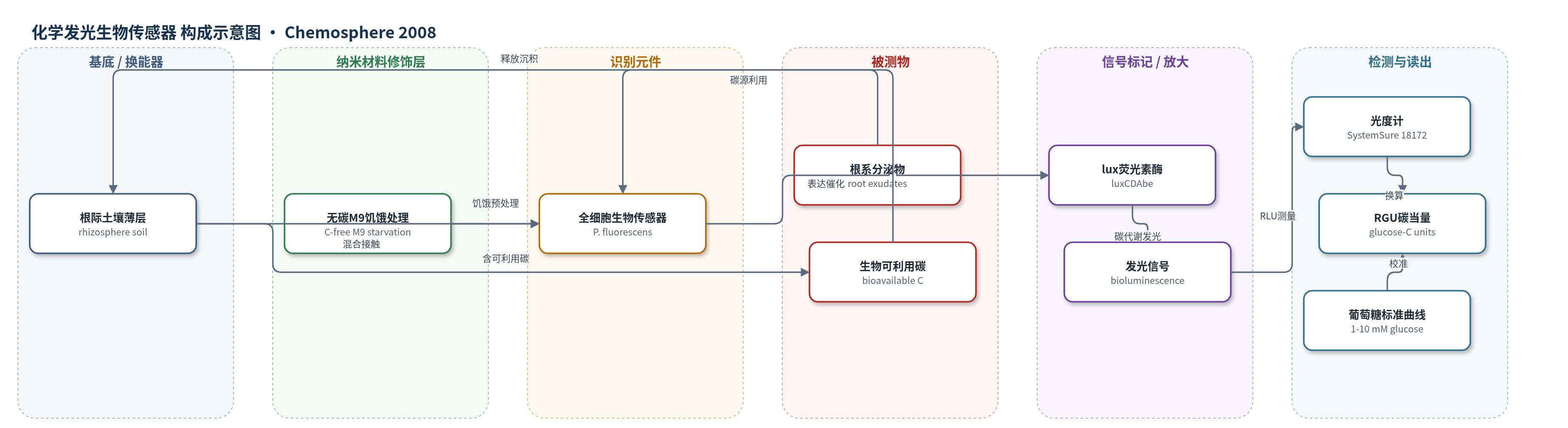
点击图片查看大图 · 依据论文自动绘制
传感器类型
化学发光生物传感器
检测对象
生物可利用有机碳(bioavailable organic carbon, bioavailable C)、根系释放有机碳(rhizodeposited organic carbon);样品基质:玉米根际土壤薄层(rhizosphere soil, 0–2/2–4/4–6 mm)
检测原理
将饥饿处理的 Pseudomonas fluorescens 10586 pUCD607 加入根际土壤样品后,细菌以样品中生物可利用有机碳(糖类、有机酸等根系分泌物)为碳源进行代谢。该菌株携带 luxCDAbe 基因簇,在通用代谢启动子控制下表达荧光素酶;碳源利用增强细胞代谢并驱动发光反应,产生与可利用碳浓度正相关的生物发光。发光强度由光度计以相对发光单位(RLU)读出,再经 1–10 mM 葡萄糖标准曲线换算为葡萄糖碳当量(RGU,μmol glucose-C/g soil)。无碳 M9 饥饿处理降低本底发光,提高对根际碳沉积的响应;方法未使用 HCR、RCA 或 CRISPR-Cas 等体外放大,而依赖全细胞代谢与荧光素酶催化发光实现信号转换。
检测灵敏度
线性范围: 1–10 mM 葡萄糖碳(glucose-C);R^2 > 0.97
效应效果
TOC 测定值为 8.4–9.6 g kg-1,各处理中非根际土壤与根际土壤无显著差异,说明 TOC 难以分辨根际可利用碳变化。发光生物传感器则检测到处理、取样层及交互作用均显著(P<0.001)。根际前 2 mm 中可利用碳浓度为 1.69(对照)、1.09(COM)、2.87(HiDOM)、4.73(HoDOM)和 2.14(TEA)μmol C g-1 soil g-1 roots,其中 HoDOM 最高。生物传感器与 TOC 的总体相关较弱(R^2=0.09),但在 TEA 处理内相关较强(R^2=0.78, P<0.001),表明其对生物可利用碳更敏感。作者认为根箱–生物传感器集成方法可定量评估有机改良对玉米根系碳释放的影响,适用于农业土壤碳循环研究。
传感器的构成
- 识别/换能元件:Pseudomonas fluorescens 10586 pUCD607 全细胞生物传感器,携带 luxCDAbe 基因,响应生物可利用碳并产生发光信号
- 信号标记物:lux 基因簇(luxCDAbe,源自 Vibrio fischeri)编码荧光素酶,在通用代谢启动子下表达,将碳代谢转化为光信号
- 培养与饥饿介质:LB 肉汤培养至 OD550=2.0,再用无碳 M9 最小培养基饥饿 2 h,降低本底发光并提高碳源响应
- 选择性维持剂:卡那霉素(kanamycin, 50 μg/mL),维持 pUCD607 抗性并抑制杂菌
- 样品反应基质:根际土壤样品(rhizosphere soil, 100 mg)与饥饿菌液(1 mL)混合,20 min 接触后取 800 μL 测定
- 校准标准:葡萄糖标准溶液(1–10 mM C),建立 RLU 与葡萄糖碳当量(RGU)校准曲线
- 信号读出装置:SystemSure luminometer Model 18172,测量相对发光单位 RLU(1 RLU=1 mV/10 s)
中文摘要
本研究测定了玉米(Zea mays L.)根系在施用堆肥及其可溶组分土壤中释放的有机碳。根箱系统中,上层土壤与根系通过尼龙膜与下层根际土壤分隔;处理仅施加于上层,下层用发光生物传感器测定根系释放的生物可利用有机碳(根际沉积)。根箱–植物系统分别施用堆肥(COM)、堆肥水提物(TEA)以及从堆肥溶解有机质(DOM)中分离的疏水组分(HoDOM)和亲水组分(HiDOM)。根系发育后,对未处理下层取样并切成薄层,用 lux 标记生物传感器 Pseudomonas fluorescens 10586 pUCD607 测定各层生物可利用有机碳,并与总有机碳(TOC)分析比较。TOC 为 8.4–9.6 g kg-1,各处理中非根际土壤与根际土壤无显著差异;而生物传感器检测到不同有机材料处理下根际土壤可利用碳化合物存在显著差异。根际前 2 mm 中可利用有机化合物浓度分别为 1.69(对照)、1.09(COM)、2.87(HiDOM)、4.73(HoDOM)和 2.14(TEA)μmol C g-1 soil g-1 roots。该根箱–生物传感器集成方法成功检测并量化了有机改良对玉米根系释放有机碳的影响,可用于评估农业土壤及土壤–大气碳循环。
英文摘要
We determined the organic carbon released by roots of maize plants (Zea mays L.) when grown in soils amended with compost and its soluble fractions. In rhizobox systems, soil and roots are separated from the soil of a lower compartment by a nylon membrane. Treatments are applied to the upper compartment, while in the lower compartment luminescent biosensors measure the bioavailable organic carbon released by roots (rhizodeposition). The rhizobox-plants systems were amended with a compost (COM), its water extract (TEA), the hydrophobic (HoDOM) and hydrophilic (HiDOM) fractions of the dissolved organic matter (DOM) extracted from the compost. After root development, the lower untreated compartments were sampled and sliced into thin layers. The bioavailable organic carbon in each layer was assessed with the lux-marked biosensor Pseudomonas fluorescens 10586 pUCD607, and compared with total organic carbon (TOC) analyses. The TOC values ranged between 8.4 and 9.6 g kg(-1) and did not show any significant differences between bulk and rhizosphere soil samples in any treatment. Conversely, the biosensor detected significant differences in available C compounds for rhizosphere soils amended with various organic materials. Concentrations of available organic compounds in the first 2 mm of soil rhizosphere were 1.69 (control), 1.09 (COM), 2.87 (HiDOM), 4.73 (HoDOM) and 2.14 (TEA)micromol Cg(-1) soil g(-1) roots. The applied rhizobox-biosensor integrated method was successful in detecting and quantifying effects of organic amendments on organic carbon released by maize plant roots. This approach may become important in assessing the carbon cycle in agricultural soils and soil-atmosphere compartments.