组成图示
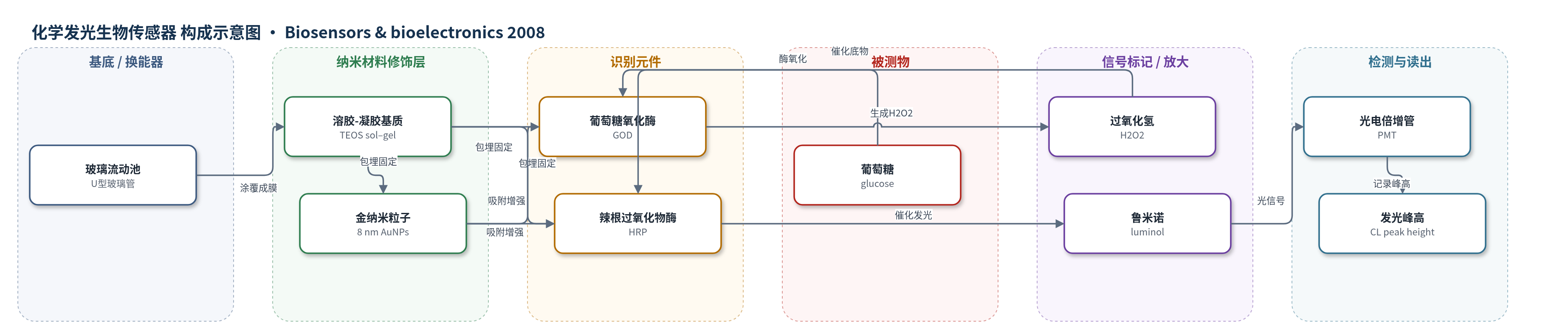
点击图片查看大图 · 依据论文自动绘制
传感器类型
化学发光生物传感器
检测对象
葡萄糖(glucose, D-glucose);样品基质:人血清(human serum)、标准溶液/磷酸盐缓冲液
检测原理
葡萄糖进入流动池后,被固定在溶胶-凝胶膜中的GOD催化氧化,生成D-葡萄糖酸和H2O2;H2O2随流动相到达HRP作用区,在HRP催化下氧化鲁米诺,产生激发态3-氨基邻苯二甲酸盐,退激时发射CL光。8 nm AuNPs与GOD、HRP相互作用,通过电子注入/抽取效应促进酶活性中心电子转移,提高GOD对葡萄糖的亲和力和催化活性,使表观Km由2.0降至0.3 mmol/L,并增强H2O2生成与CL信号。葡萄糖浓度越高,H2O2生成越多,CL峰高越大,从而实现定量检测。
检测灵敏度
LOD: 5 × 10⁻⁶ mol L−1 (3σ);线性范围: 1.0 × 10⁻⁵ mol L−1 to 1.0 × 10⁻³ mol L−1;回归方程: I = 16.7C × 10^4 + 63.8;R^2 = 0.9965
效应效果
8 nm AuNPs使CL响应增强超过20倍,GOD表观Km由2.0降至0.3 mmol/L。1.0×10−3 mol/L葡萄糖RSD<2%(n=9),分析约80 s;100次测定1.0×10⁻⁴ mol/L RSD<5%,150次后信号降35%,可重复约100次。生理浓度干扰物对5.6×10⁻³ mol/L葡萄糖干扰为3–7%。3份血清结果7.7、4.4、5.3 mmol/L(RSD 1.1–1.3%),与医院分光光度法8.0、4.5、5.5 mmol/L接近。酶用量为先前1/10,成本低,可换酶用于尿酸、乳酸。
传感器的构成
- 基底/流动池:U形无色玻璃管(U-shaped colorless glass tube, 100 mm, i.d. 3 mm),作为CL流动池和酶反应腔
- 溶胶-凝胶固定层:四乙基原硅酸盐(TEOS)溶胶-凝胶基质,包埋并固定AuNPs、GOD和HRP,形成葡萄糖敏感膜
- 纳米材料修饰层:8 nm金纳米粒子(AuNPs,柠檬酸稳定),吸附GOD和HRP并增强酶活性与CL响应
- 识别/催化元件:葡萄糖氧化酶(GOD)和辣根过氧化物酶(HRP),GOD氧化葡萄糖生成H2O2,HRP催化H2O2氧化鲁米诺发光
- 信号底物:鲁米诺(luminol,5×10−4 mol/L),作为CL底物被HRP/H2O2体系氧化发光
- 载流/缓冲介质:磷酸盐缓冲液(PBS,pH 8.5),作为载体液和酶反应/CL反应介质
- 检测读出:CR-105光电倍增管(PMT)与BPCL超微弱发光分析仪,记录CL峰高
中文摘要
本文提出一种用于葡萄糖检测的新型化学发光(CL)流动生物传感器。葡萄糖氧化酶(GOD)、辣根过氧化物酶(HRP)和金纳米粒子(AuNPs)通过溶胶-凝胶法共同固定在CL流动池内表面。检测时,GOD催化葡萄糖氧化生成D-葡萄糖酸和过氧化氢(H2O2),生成的H2O2在HRP催化下氧化鲁米诺产生CL发射。结果表明,AuNPs可显著增强葡萄糖生物传感器的CL响应,且增强效果与金胶粒尺寸密切相关,尺寸越小响应越高。研究优化了固定条件和CL反应条件。CL发射强度与葡萄糖浓度在1.0×10⁻⁵~1.0×10⁻³ mol/L范围内呈线性,检出限为5×10−6 mol/L(3σ)。GOD在AuNPs/溶胶-凝胶基质中的表观Michaelis-Menten常数为0.3 mmol/L,低于无AuNPs的溶胶-凝胶基质。该传感器响应时间短、操作简便、成本低、组装简单,并成功用于人血清中葡萄糖的测定。
英文摘要
In this work, a novel chemiluminescence (CL) flow biosensor for glucose was proposed. Glucose oxidase (GOD), horseradish peroxidase (HRP) and gold nanoparticles were immobilized with sol-gel method on the inside surface of the CL flow cell. The CL detection involved enzymatic oxidation of glucose to d-gluconic acid and H(2)O(2), and then the generated H(2)O(2) oxidizing luminol to produce CL emission in the presence of HRP. It was found that gold nanoparticles could remarkably enhance the CL respond of the glucose biosensor. The enhanced effect was closely related to the sizes of gold colloids, and the smaller the size of gold colloids had the higher CL respond. The immobilization condition and the CL condition were studied in detail. The CL emission intensity was linear with glucose concentration in the range of 1.0 x 10(-5)molL(-1) to 1.0 x 10(-3)molL(-1), and the detection limit was 5 x 10(-6)molL(-1) (3sigma). The apparent Michaelis-Menten constant of GOD in gold nanoparticles/sol-gel matrix was evaluated to be 0.3mmolL(-1), which was smaller than that of GOD immobilized in sol-gel matrix without gold nanoparticles. The proposed biosensor exhibited short response time, easy operation, low cost and simple assembly, and the proposed biosensor was successfully applied to the determination of glucose in human serum.