组成图示
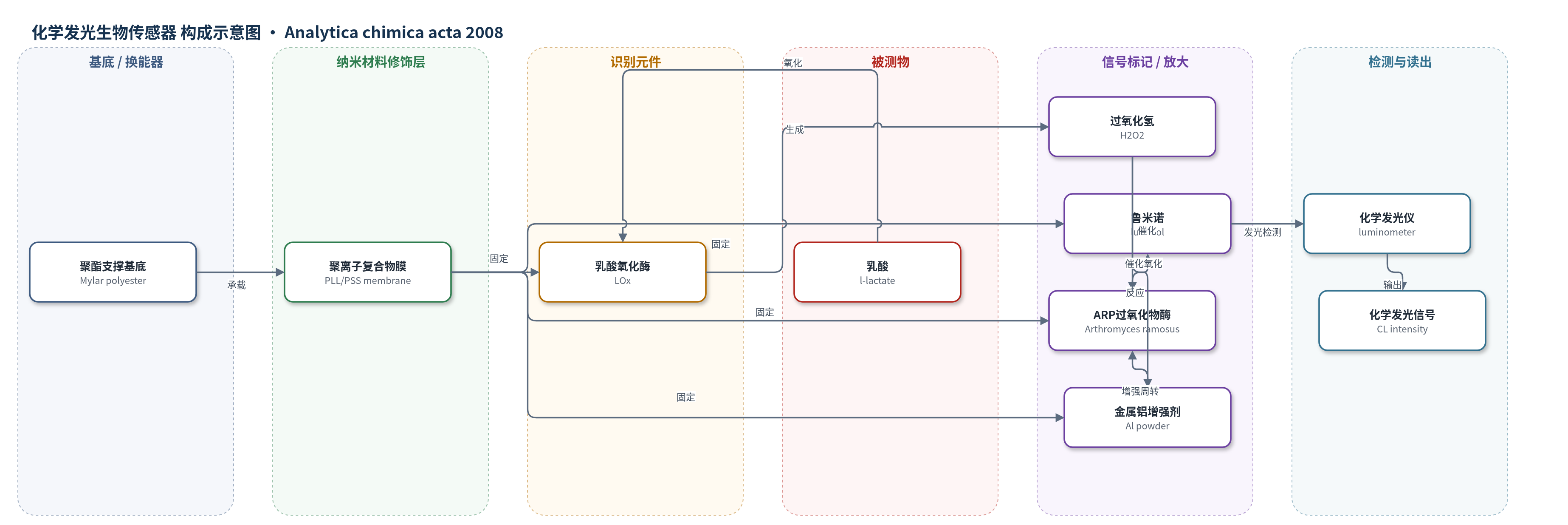
点击图片查看大图 · 依据论文自动绘制
传感器类型
化学发光生物传感器
检测对象
乳酸(lactate,l-lactate);样品基质为酸奶(yoghurt)稀释滤液及Tris缓冲水溶液
检测原理
乳酸进入由PLL/PSS构成的聚离子复合物膜后,被LOx催化氧化为丙酮酸,同时生成H2O2。H2O2与膜内luminol在碱性环境中反应;ARP催化luminol氧化,经Compound I等中间态形成激发态3-氨基邻苯二甲酸根二价阴离子,退激发射化学发光。金属铝粉与H2O2作用产生自由基并促进ARP周转,增强发光且基本不增加空白。乳酸浓度越高,H2O2生成越多,CL相对信号越大。信号在luminometer中积分采集,典型采集时间为2 min,并对乳酸浓度取对数线性化。
检测灵敏度
LOD: 9.2 × 10⁻⁶ M (2 min);LOD: 3.5 × 10⁻⁵ M (30 s);线性范围: 5 × 10⁻⁵–4 × 10⁻³ M;灵敏度斜率: 65.4 (2 min)、168.3 (30 s);r: 0.998 (2 min)、0.971 (30 s)
效应效果
该传感器对酸奶稀释液中葡萄糖、抗坏血酸、尿酸及乙酸、柠檬酸等共存物无干扰,选择性来自LOx酶促反应和聚离子复合物膜的选择透过性。10个一次性传感器在不同乳酸浓度下2 min采集RSD约3–8%,30 s为10–15%;8×10⁻⁴ M乳酸RSD为5.5%。4 ℃避光保存寿命超过1个月,22 d信号下降1.0%,30 d下降10.1%,35 d下降45.6%,45 d下降95.1%。酸奶样品测定结果与Boehringer-Mannheim酶法参考方法比较,方法比较百分比为96.8%、99.8%和102.8%,总体在95–105%。作者认为方法快速、廉价、灵敏,适合酸奶等现场检测。
传感器的构成
- 支撑基底:Mylar型聚酯片(Mylar-type polyester sheet),承载可丢弃传感膜并提供机械支撑。
- 聚离子复合物膜:poly-l-lysine(PLL)与poly(sodium 4-styrenesulfonate)(PSS)形成聚离子复合物膜,固定酶和发光试剂并允许乳酸透过。
- 识别元件:lactate oxidase(LOx),催化乳酸氧化为丙酮酸并产生H2O2。
- 化学发光底物:luminol(鲁米诺),在碱性条件下被氧化并发射化学发光。
- 催化酶:peroxidase from Arthromyces ramosus(ARP),催化鲁米诺-H2O2化学发光反应。
- 信号增强剂:metallic aluminum powder(Al,<75 μm),通过促进ARP周转/产生自由基增强化学发光。
- 缓冲介质:Tris buffer(pH 8.8),维持酶活性和化学发光反应环境。
中文摘要
本文报道了一种基于化学发光的一次性乳酸生物传感器。识别系统采用乳酸氧化酶(LOx),换能系统由鲁米诺、来自Arthromyces ramosus的过氧化物酶(ARP)和金属铝组成,并全部固定于聚离子复合物膜中。将1 mL样品注入装有可丢弃传感膜的常规比色皿后,在化学发光仪中测量化学发光信号即可测定乳酸。作者优化了膜组成和反应条件以获得合适灵敏度。该一次性传感器对乳酸响应迅速,典型化学发光采集时间为2 min,经对数线性化后动态范围为5×10⁻⁵至4×10⁻³ M,检出限为9.2×10⁻⁶ M,在量程中点传感器间重现性RSD为5.5%。该化学发光一次性传感器用于酸奶中乳酸分析,并与酶法参考程序验证。方法快速、廉价、灵敏,使用常规化学发光仪器。
英文摘要
A new chemiluminescence-based one-shot biosensor for lactate is described. The lactate recognition system is based on lactate oxidase (LOx) and the transduction system consists of luminol, peroxidase from Arthromyces ramosus (ARP) and metallic aluminum, all immobilized in a polyion complex membrane. The measurement of the chemiluminescence in a luminometer when 1 mL of sample is injected into a conventional cell containing the disposable sensing membrane makes it possible to determine lactate. The compositions of the membrane and reaction conditions have been optimized to obtain adequate sensitivity. The one-shot biosensor responds to lactate rapidly, with the typical CL acquisition time being 2 min, with a linearized logarithmic dependence whose dynamic range was from 5 x 10(-5) to 4 x 10(-3) with a detection limit of 9.2 x 10(-6)M and a sensor-to-sensor reproducibility (relative standard deviation, R.S.D.) of 5.5% at the medium level of the range. The performance of the chemiluminescent one-shot biosensor was tested for the analysis of lactate in yoghurt, validating the results against an enzymatic reference procedure. The proposed method is quick, inexpensive and sensitive and uses conventional CL instrumentation.