组成图示
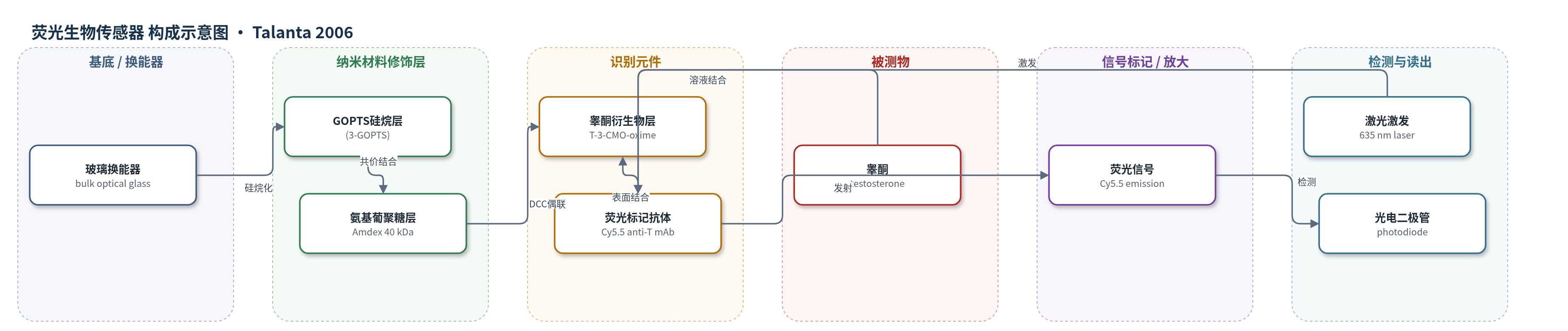
点击图片查看大图 · 依据论文自动绘制
传感器类型
荧光生物传感器
检测对象
睾酮(testosterone);样品基质:Milli-Q 水、饮用水、河水等水样
检测原理
该传感器采用异质竞争免疫分析。玻璃换能器表面经 GOPTS 硅烷化、氨基葡聚糖修饰后,共价固定睾酮衍生物 testosterone-3-(O-carboxymethyl)oxime 作为捕获配体。样品中的睾酮与 Cy5.5 标记的抗睾酮单克隆抗体在溶液中孵育,睾酮占据抗体结合位点,使可结合表面衍生物的抗体减少。未结合抗体随后结合到表面捕获层,其 Cy5.5 荧光染料位于玻璃表面倏逝场范围内。635 nm 激光在玻璃中全内反射,倏逝场激发近表面荧光,发射光经 690 nm 截止滤光片收集并由光电二极管锁相检测。表面高亲和位点过量使结合处于质量传输限制状态,信号主要反映溶液中自由抗体浓度。睾酮浓度越高,表面结合荧光抗体越少,荧光信号越低;相对信号与浓度用四参数 logistic 函数拟合。
检测灵敏度
LOD: 0.2 ng L−1;LOQ: 5.2 ng L−1;MDC: 0.9 ng L−1;RDL: 2.2 ng L−1;工作范围: 约 1.5 ng L−1–5.5 µg L−1;10–90%动态范围: 7.4 ng L−1–2.9 µg L−1
效应效果
该传感器在真实水样中表现稳健。第二批次抗体(15 ng/样品)下,Milli-Q 水、饮用水和河水加标 0.9、9、90 ng L−1,三次测定相对信号误差 0.7%–2.1%,平均回收率 78.4%–118.2%,误差 4.9%–20.0%,符合 AOAC 70%–120% 要求。第一批次 30 ng 抗体下,饮用水加标 45、90 ng L−1 回收率分别为 75.0±9.6%、108.3±13.8%。表面可用 0.5% SDS(pH 2)再生约 1000 次。相比 GC–MS 需 10^4 倍富集和衍生化、睾酮定量限约 1–10 ng L−1,本方法无需预处理,LOD 0.2 ng L−1,适合低成本环境监控与预警。
传感器的构成
- 基底/换能器:bulk optical glass transducer,承载全内反射倏逝场并作为光学换能器
- 硅烷化层:(3-glycidyloxypropyl)trimethoxysilane(GOPTS),在玻璃表面提供环氧基团用于共价偶联
- 抗非特异/间隔层:aminodextran Amdex 40 kDa,减少非特异结合并增加表面功能化位点
- 捕获配体层:testosterone-3-(O-carboxymethyl)oxime 衍生物,经 DCC 活化酯共价固定,提供抗睾酮抗体结合位点
- 识别元件:anti-testosterone monoclonal antibody(Acris BM2076, clone 7003, IgG1),在溶液中与睾酮竞争结合
- 信号标记物:CyDye Cy5.5 荧光染料,标记抗体,位于倏逝场范围内被激发
- 读出系统:635 nm 激光、聚合物光纤、690 nm 截止吸收滤光片和光电二极管锁相检测,采集表面荧光信号
中文摘要
目前,快速且低成本监测多种水源的技术仍然不足。超灵敏、全自动且稳健的生物传感器 River Analyser(RIANA)能够在异质检测格式(固相:体光学玻璃换能器)中快速同时检测多种有机目标。此类传感器的商业化需要可商用的超高亲和识别元件(如抗体)以及适合表面化学的商用半抗原(修饰目标分子)。因此,作者选择睾酮作为模型分析物,因为环境样品中常需检测亚纳克每升级别,这也是气相色谱–质谱(GC–MS)等常规方法面临的挑战。反射干涉光谱(RIfS)用于表征商用免疫化学,未标记抗体的亲和常数为 2.6±0.3×10^9 mol−1。标记后,基于 RIfS(1.4±0.4×10^9 mol−1)和 TIRF(1.0±0.3×10^9 mol−1)计算得到平均亲和常数 1.2×10^9 mol−1。随后,TIRF 生物传感器用于真实样品中无需预处理或预浓缩地检测睾酮。结果显示,水样中睾酮的快速超灵敏分析检出限(LOD)为 0.2 ng L−1。所有真实样品,包括亚纳克每升级别(如 0.9 ng L−1),回收率均在 70%–120% 之间。因此,该系统适合作为低成本环境监测与预警系统,补充常规分析方法。首次使用无标记检测法 RIfS 完整表征商用免疫化学,并成功纳入 TIRF 生物传感器 RIANA,实现水环境样品中亚纳克每升级别睾酮的可靠检测。
英文摘要
Nowadays, little technology exists that can monitor various water sources quickly and at a reasonable cost. The ultra-sensitive, fully automated and robust biosensor River Analyser (RIANA) is capable of detecting multiple organic targets rapidly and simultaneously at a heterogeneous assay format (solid phase: bulk optical glass transducers). Commercialization of such a biosensor requires the availability of commercial high-affinity recognition elements (e.g. antibodies) and suitable commercial haptens (modified target molecules) for surface chemistry. Therfore, testosterone was chosen as model analyte, which is also a task of common analytical methods like gas chromatography-mass spectrometry (GC-MS), because they have to struggle with detecting sub-nanogram per liter levels in environmental samples. The reflectometric interference spectroscopy (RIfS) was used to characterize the commercially available immunochemistry resulting in a high-affinity constant of 2.6+/-0.3 x 10(9)mol(-1) for the unlabeled antibody. After the labeling procedure, necessary for the TIRF-based biosensor, a mean affinity constant of 1.2 x 10(9)mol(-1) was calculated out of RIfS (1.4+/-0.4 x 10(9)mol(-1)) and TIRF (1.0+/-0.3 x 10(9)mol(-1)) measurements. Thereafter, the TIRF-based biosensor setup was used to determine the steroidal hormone testosterone at real world samples without sample pre-treatment or sample pre-concentration. Results are shown for rapid and ultra-sensitive analyses of testosterone in aqueous samples with at a remarkable limit of detection (LOD) of 0.2 ng L(-1). All real world samples, even those containing testosterone in the sub-nanogram per liter range (e.g. 0.9 ng L(-1)), could be determined with recovery rates between 70 and 120%. Therefore, the sensor system is perfectly suited to serve as a low-cost system for surveillance and early warning in environmental analysis in addition to the common analytical methods. For the first time, commercially available immunochemistry was fully characterized using a label-free detection method (RIfS) and successfully incorporated into a TIRF-based biosensor setup (RIANA) for reliable sub-nanogram per liter detection of testosterone in aqueous environmental samples.