组成图示
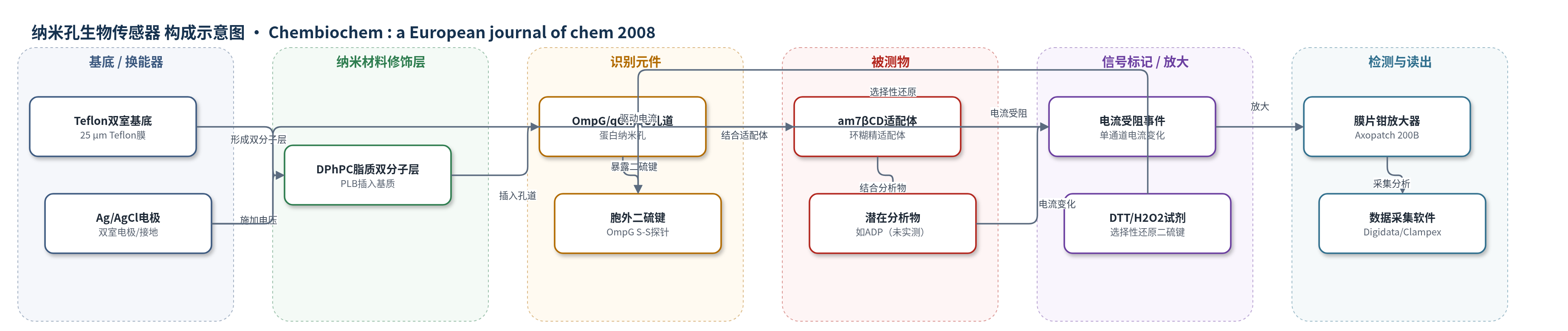
点击图片查看大图 · 依据论文自动绘制
传感器类型
纳米孔生物传感器
检测对象
七(6-脱氧-6-氨基)-β-环糊精 (am7βCD)(样品基质:10 mM Tris HCl/1 M KCl 缓冲液);潜在分析物 5'-二磷酸腺苷 (ADP)(样品基质:缓冲液,文中仅提及适配体可结合,未实际检测)
检测原理
OmpG或qOmpG插入DPhPC平面脂质双分子层后形成蛋白纳米孔,Ag/AgCl电极在双室间施加电压,K+离子电流通过孔道。am7βCD从周质端进入孔道并与孔道结合,造成瞬态电流受阻;结合事件的幅度、驻留时间和出现频率随电压变化,从而反映适配体结合。若分析物(如ADP)进一步结合于am7βCD,会改变剩余电流,实现随机传感。取向判定利用胞外二硫键:DTT从一侧选择性还原二硫键,使门控概率和事件幅度改变,据此判断孔道朝向。该体系不依赖酶催化或核酸放大,信号放大主要来自单通道事件统计和电压依赖驻留时间。
检测灵敏度
原文未报告LOD、线性范围、灵敏度斜率或相关系数。
效应效果
未报告选择性、抗干扰、稳定性、RSD、回收率或方法对比。OmpG在DPhPC双分子层中双向插入,Q-/N+与Q+/N-比例约6:4(n=30)。DTT判定中,Q+/N-孔道cis侧加DTT后Pgating由0.013升至0.055,事件幅度升高;trans侧加DTT无变化,Q-/N+相反。am7βCD从周质端结合qOmpG呈约80%电流受阻,驻留时间0.24±0.06 ms(n=3)并随电压指数增加;从胞外端多为<50%受阻、驻留<0.1 ms,>75 mV出现95%受阻群体。周质端结合更稳定,利于qOmpG传感器开发。
传感器的构成
- 换能器/基底:Teflon 薄膜(25 μm厚、约100 μm孔径)与 Ag/AgCl 电极,构成双室并施加电压、记录离子电流
- 脂质双分子层:1,2-diphytanoyl-sn-glycero-3-phosphocholine (DPhPC) 在 Teflon 孔上形成平面脂质双分子层 (PLB),作为蛋白孔道插入基质
- 传感孔道/识别元件:外膜蛋白 G (OmpG) 或安静突变体 qOmpG (OmpG S-S/Asp215 deletion) 插入 PLB,形成单通道蛋白纳米孔,其门控和电流受阻事件反映结合事件
- 分子适配体/信号标记物:heptakis-(6-deoxy-6-amino)-β-cyclodextrin (am7βCD) 结合 qOmpG 孔道,作为可结合分析物的适配体,结合后改变离子电流
- 取向判定试剂:DTT 与 H2O2 分别加入 cis/trans 室,选择性还原胞外二硫键,用于判定孔道绝对取向
- 信号读出:Axopatch 200B 膜片钳放大器、Digidata 1320 A/D 板与 Clampex 软件,记录单通道电流并分析事件
中文摘要
外膜蛋白G(OmpG)是大肠杆菌来源的非选择性单体孔蛋白,因单体结构而适合作为随机传感元件。本文在平面脂质双分子层(PLB)中研究由去污剂稀释法插入的单个OmpG孔道,发现其电流-电压关系和电压依赖门控具有明显不对称性,并据此建立判断孔道取向的规则。作者在OmpG胞外环中引入两个半胱氨酸形成二硫键,DTT切割该二硫键会显著增加自发门控。通过分别向cis或trans侧加入DTT,证明在负电位下呈安静迹线的孔道为trans取向(胞外环位于trans侧),在正电位下呈安静迹线的孔道为cis取向(胞外环位于cis侧)。在此基础上,作者考察七(6-脱氧-6-氨基)-β-环糊精(am7βCD)与安静突变体qOmpG的结合:从胞外面加入时出现瞬态多部位相互作用;从周质面加入时出现更稳定的单部位相互作用。由于am7βCD可作为结合分析物的分子适配体,该取向与结合信息有助于推进OmpG作为生物传感器的应用。
英文摘要
Outer membrane protein G (OmpG) is a non-selective porin from Escherichia coli. OmpG is a monomer, which makes it unusual among porins, and suggests that it may be useful in biotechnology. In planar lipid bilayers, individual OmpG pores reconstituted by insertion from detergent exhibit pronounced asymmetry in current-voltage relationships and voltage-dependent gating. Here, this asymmetry is used to deduce the orientation of OmpG in the bilayers. We introduced two cysteines into the extracellular loops of OmpG. Cleavage of the disulfide bond formed by these residues significantly increases spontaneous gating of the pore. By adding DTT to one side of the bilayer or the other, we demonstrated that pores showing a quiet trace at negative potentials have a "trans" conformation (extracellular loops on the trans side of the bilayer), while pores showing a quiet trace at positive potentials have a "cis" conformation (extracellular loops on the cis side). With this knowledge, we examined the binding of a cyclodextrin to OmpG. When the cyclodextrin was presented to the extracellular face of the pore, transient multisite interactions were observed. In contrast, when the cyclodextrin was presented to the periplasmic face, a more stable single-site interaction occurred. Because the cyclodextrin can act as a molecular adapter by binding analytes, this information serves to advance the use of OmpG as a biosensor.